hauyeedoin · Portfolio Field Report No. 04 Maguro Group · Design Operations · 2026
Workflow Analysis · Knowledge Mapping · Design Operations

Mapping a business that existed
only in people's heads

Store openings arrived as disconnected design tasks rather than documented workflows. By recording, comparing and reverse engineering recurring requests, I gradually reconstructed the relationships between them, transforming fragmented observations into reusable operational knowledge.

Client Maguro Group Project Design operations Role Creative Designer Scope Workflow analysis · knowledge mapping Period March – August 2026
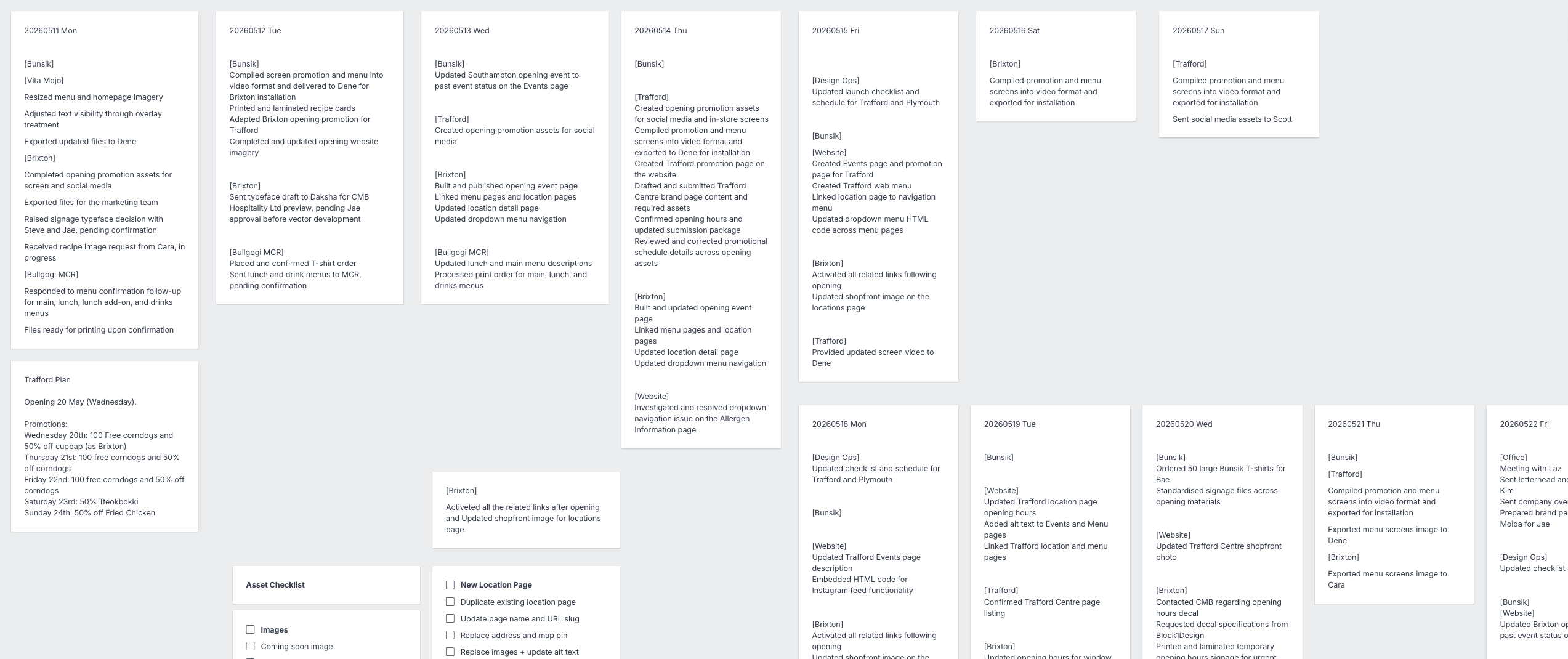
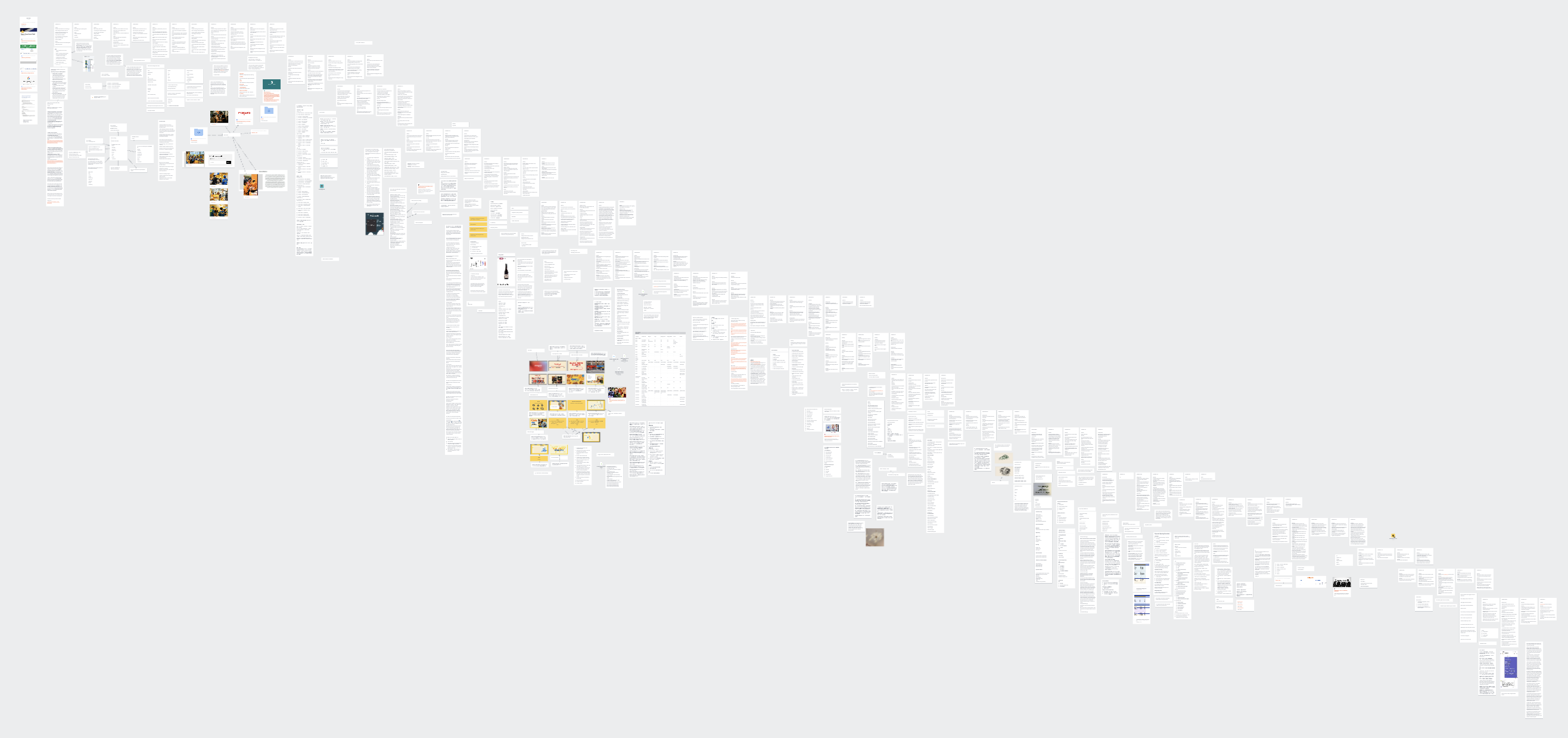
Six months of accumulated observations in a Milanote knowledge map
Six months of accumulated observations. Rather than isolated notes, this became the knowledge base from which recurring patterns gradually emerged.
Introduction

When I joined the company, there wasn't a document explaining how a new store opening worked. Design requests arrived as individual tasks, often detached from the conversations that generated them. I knew what needed to be designed, but not how each task related to the wider business.

Instead of waiting until I understood everything, I started recording everything. From my first day, every task was added to my work log. At first it was simply a personal reference. I wasn't trying to document the business. I was trying to understand it.

As the weeks passed, those notes became more than a record of completed work. Patterns began to emerge.

Work log – daily record
Daily work log showing tasks recorded before their relationships were understood
Every incoming task was recorded before I understood how it fitted into the wider business.

Reverse engineering the workflow

Rather than treating every task independently, I started comparing them. Not asking what needed to be designed, but asking why it appeared at that particular moment.

Each completed project became another reference point. Repeated requests gradually revealed recurring relationships. Some deliverables consistently followed construction drawings. Some only appeared after menu approvals. Certain production work repeatedly required longer supplier lead times than others.

Instead of documenting individual tasks, I started documenting their relationships.

The first outcome was a simple checklist. It wasn't intended to become company documentation. It was a working model that helped me understand what normally happened next.

Before relying on it, I reviewed the structure with our junior designer, who had previously participated in an earlier store opening. The discussion helped distinguish existing practice from my own assumptions before the checklist became the foundation for future openings.

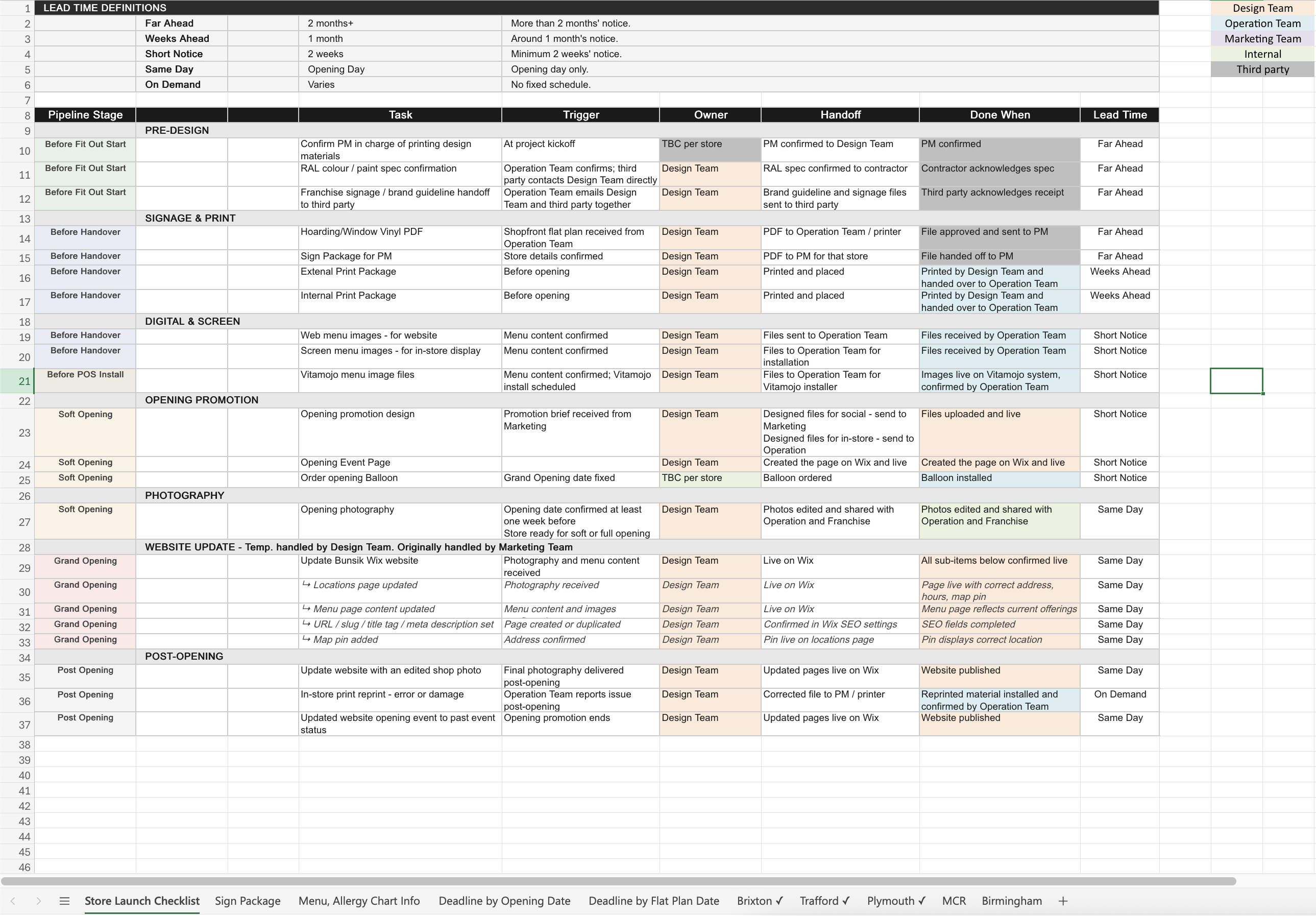
Opening checklist – operational framework
Store opening checklist showing pipeline stages, triggers, owners and lead times
Recurring observations organised into a practical operational framework. Pipeline stages, triggers, ownership and lead times emerged through repeated projects rather than from a written brief.

What the checklist was actually solving

As the checklist became more detailed, it also began solving a different problem. Many of the workflows weren't actually missing. They already existed across conversations, habits and individual experience. The difficulty was that different teams often understood different parts of the same process.

This is common in rapidly growing businesses where processes evolve faster than documentation. As new roles, suppliers and locations are added, work is often coordinated through conversations rather than written systems. Everyone understands their own part of the process, but the boundaries between teams gradually become less visible.

A website update, for example, isn't a single task. Creating the page, assigning the URL, publishing it and preparing search metadata may belong to different people. If those steps are grouped together as "update the website", each team can reasonably assume that someone else has completed the remaining work.

The purpose of documenting these workflows wasn't to create more paperwork. It was to make ownership, handovers and completion criteria explicit before work fell between teams.

"I wasn't documenting tasks. I was reconstructing the relationships between them."


Predicting instead of reacting

As more openings were completed, the relationships became increasingly predictable. Instead of responding to requests one by one, I began working backwards.

If an opening date had already been confirmed, I could estimate when each design stage needed to begin by tracing supplier lead times backwards from launch. If only construction drawings had arrived, I could estimate how far the project was from opening by comparing them with previous openings.

Each completed project either reinforced the model or revealed an exception. Every exception refined the framework.

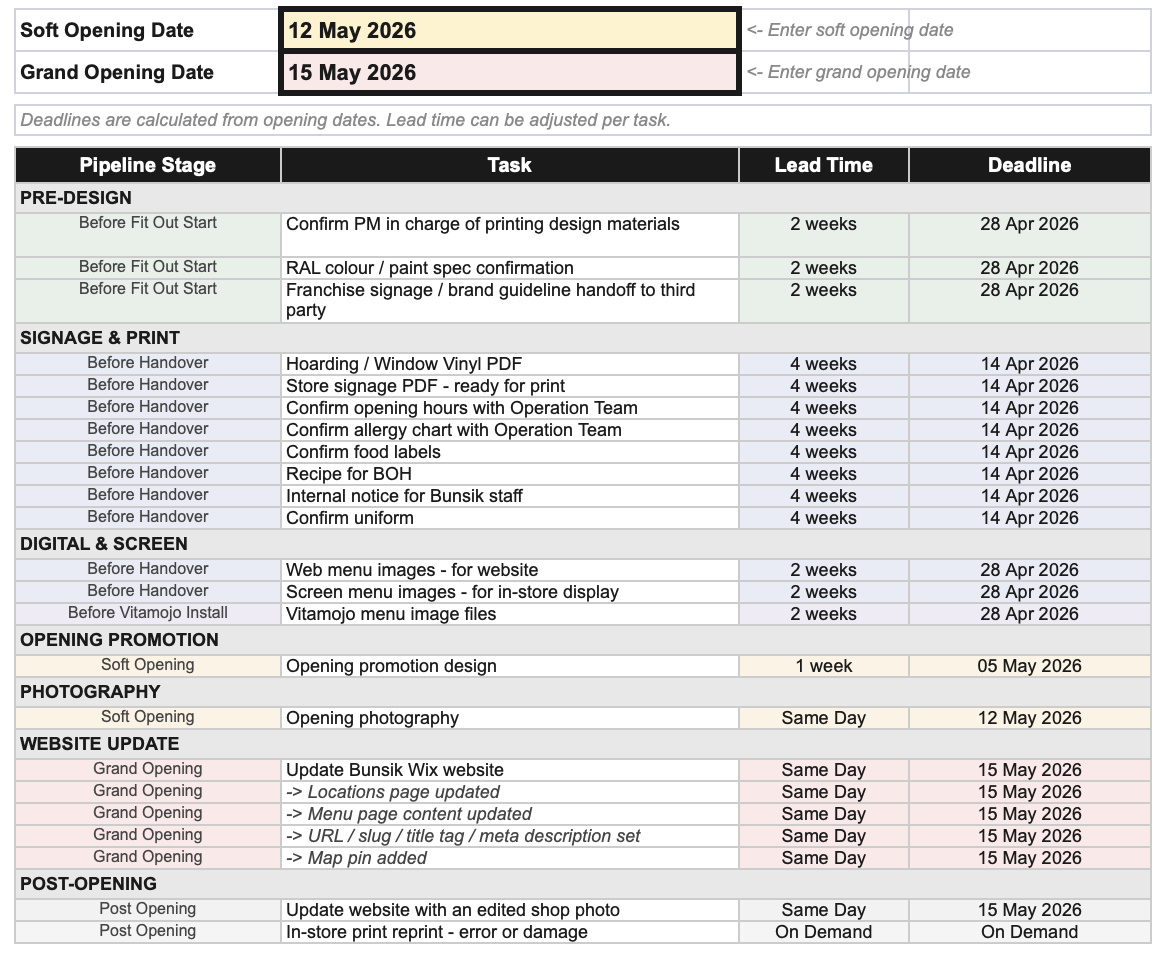
Deadline calculator – opening date model
Deadline calculator showing tasks with lead times calculated backwards from opening date
Repeated observations became a predictive timeline rather than a reactive task list. Enter an opening date; every deadline calculates automatically.

Externalising operational knowledge

As the framework matured, individual documents naturally evolved for different purposes. Some helped forecast future work. Others organised recurring deliverables across brands.

Together they externalised knowledge that had previously existed only through experience.

Observe.
Record.
Compare.
Infer.
Validate.
Refine.

None of these documents were the objective. The checklist. The timeline. The planning references. They were simply evidence of a way of working.

Looking back, I realised I wasn't trying to create a process. I was trying to understand one well enough that it no longer depended on memory, assumptions or informal conversations.

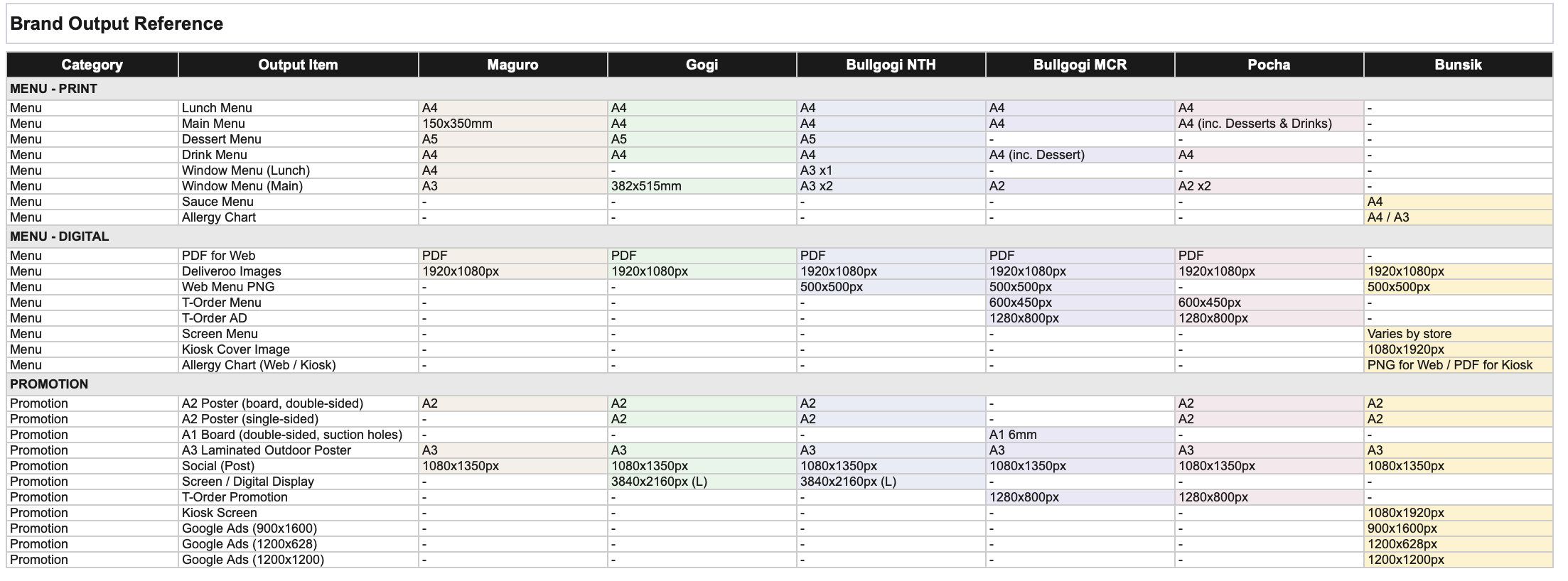
Brand output reference – cross-brand format library
Cross-brand format library showing output specifications across all Maguro Group brands
Different documents solving different parts of the same operational understanding. Every brand, every output type, every format – mapped in one place.
6
Months of iteration
Continuously refining the workflow through live projects
6
Pipeline stages
Mapping work from pre-design through post-opening
6
Brands mapped
Maguro, Gogi, Bullgogi NTH, Bullgogi MCR, Pochawa Grill, Bunsik
0
Prior documentation
Framework developed from operational observation
← Back to portfolio ← Back to reports Next: Franchise content →
hauyeedoin.com · 2026